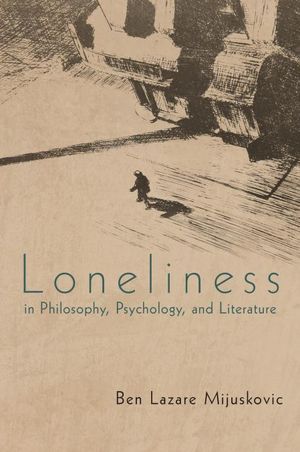
Review of Loneliness by Ben Mijuskovic

We are appreciative for Kerrin A. Jacobs’s complementary review of Loneliness for Metapsychology Online Reviews:

In summary, Loneliness in Philosophy, Psychology, and Literature is a memorable book which certainly appeals a philosophically inclined audience. Ben Lazare Mijuskovic thoughtfully and stringently develops his hypotheses, which are very often remarkably clear, presented against a delicately rich and complex theoretical background. Mijuskovic rewards the reader with thought-provoking moments and invites one to further reflect the critical potential and actuality of his theory in the light of the most recent theories of an embodied, embedded, enacted and extended mind.

Click here to read the full review.

Another Installment by Springer

Fresh translations of key texts, exhaustive coverage from Plato to Kant, and detailed commentary by expert scholars of philosophy add up to make this sourcebook the first and most comprehensive account of the history of the philosophy of mind. Published at a time when the philosophy of mind and philosophical psychology are high-profile domains in current research, the volume will inform our understanding of philosophical questions by shedding light on the origins of core conceptual assumptions often arrived at before the instauration of psychology as a recognized subject in its own right.

The chapters closely follow historical developments in our understanding of the mind, with sections dedicated to ancient, medieval Latin and Arabic, and early modern periods of development. The volume’s structural clarity enables readers to trace the entire progression of philosophical understanding on specific topics related to the mind, such as the nature of perception. Doing so reveals the fascinating contrasts between current and historical approaches. In addition to its all-inclusive source material, the volume provides subtle expert commentary that includes critical introductions to each thematic section as well as detailed engagement with the central texts. A voluminous bibliography includes hundreds of primary and secondary sources. The sheer scale of this new publication sheds light on the progression, and discontinuities, in our study of the philosophy of mind, and represents a major new sourcebook in a field of extreme importance to our understanding of humanity as a whole.

New Book by Richard Swinburne

Mind, Brain, and Free Will presents a powerful new case for substance dualism (the idea that humans consist of two parts–body and soul) and for libertarian free will (that humans have some freedom to choose between alternatives, independently of the causes which influence them). Richard Swinburne argues that answers to questions about mind, body, and free will depend crucially on the answers to more general philosophical questions. He begins by analyzing the criteria for one event being the same as another, one substance being the same as another, and a state of affairs being metaphysically possible; and then goes on to analyze the criteria for a belief about these issues being justified. Pure mental events (including conscious events) are distinct from physical events and interact with them. Swinburne claims that no result from neuroscience or any other science could show that interaction does not take place; and illustrates this claim by showing that recent scientific work (such as Libet’s experiments) has no tendency whatever to show that our intentions do not cause brain events. He goes on to argue for agent causation, and claims that–to speak precisely–it is we, and not our intentions, that cause our brain events. It is metaphysically possible that each of us could acquire a new brain or continue to exist without a brain; and so we are essentially souls. Brain events and conscious events are so different from each other that it would not be possible to establish a scientific theory which would predict what each of us would do in situations of moral conflict. Hence given a crucial epistemological principle (the Principle of Credulity) we should believe that things are as they seem to be: that we make choices independently of the causes which influence us. According to Swinburne’s lucid and ambitious account, it follows that we are morally responsible for our actions.

Loneliness 2nd Edition is now available

Dr. Mijuskovic’s interdisciplinary work Loneliness is now available in a second edition. You can find it on  Alibris, Amazon and Barnes & Noble.

Parker E. Lichtenstein provides a helpful synopsis in The Psychological Record:

  “The author has employed an interdisciplinary approach to the problem of loneliness. While psychologists have touched upon the problem, they have not done justice to it. Mijuskovic sees loneliness not simply as a frequent human condition but rather an aspect of man’s ontological being. In his words, man is ‘intrinsically alone and irredeemably lost’ and is ‘continually struggling to escape the solipsistic prison of his frightening solitude.’ This basic thesis is supported through philosophical analysis and wide-ranging examination of relevant literature…. [T]he author has presented a challenging picture of much human behavior as a flight from loneliness. On the whole this is an intriguing book which should be of particular interest to psychologists of a humanistic persuasion.”

Loneliness 2nd edition

Ben Mijuskovic has been tirelessly working on a second edition of his ground breaking study on loneliness. He kindly provided some reviews, which will be posted here in the coming weeks. The fundamental conclusions of the simplicity argument lead to solipsism, which translates psychologically into loneliness. Isolate minds have trouble engaging the outside world; thus, the natural emotive response to this philosophical reality is the feeling of being alone – unable to connect with other minds.

Acclaim for Ben Mijuskovic’s Loneliness in Philosophy, Psychology, and Literature

[1] “Indeed, a most impressive survey has been undertaken by Professor Ben Mijuskovic in his fine book, Loneliness in Philosophy, Psychology, and Literature. He shows most effectively how prominent the themes of literature and inwardness have been in creative literature from quite early times, in the myth of Prometheus, the Odyssey, in parts of Plato and Aristophanes, and in the Upanishads, down to the most recent writers of fiction and philosophy. ‘Robinson Crusoe’ recovers the importance it had for earlier speculative thought (the ‘History of Robinson and Friday’ as we have it in Hegel’s ‘Outlines of the Phenomenology of Mind’) and is shown to be part of a concern which continues through Proust to the British novelist Arthur Machen and his frightening portrayal, in his own words, of ‘a Robinson Crusoe of the soul’ and to Thomas Wolfe’s ‘We walk the streets of life alone’ matched by Conrad’s ‘Heart of Darkness’ and Golding’s ‘Pincher Martin.’ Mijuskovic concludes that, on the philosophical foundation of the ability of thought to “curl back on itself, the disciplines of literature, philosophy, and psychology have erected a significant and true insight into man’s fundamental nature, namely that that each of us, separately exists in isolation, in a state of desolate loneliness, enclosed within the confines of a nomadic prison which we continually strive to escape.”

H. D. Lewis, editor of Religious Studies.