Mijuskovic writes “The Simplicity Argument versus a Materialist Theory of Consciousness” to challenge A. M. Armstrong’s A Materialist Theory of Mind. The reader will immediately notice his thought is more refined in this presentation as an overarching philosophy of mind that is juxtaposed with that of Armstrong’s. Just two years after the publication of The Achilles of Rationalist Arguments, Mijuskovic presents a philosophical defense that spans more than two millennia of Western philosophy from Plato to Sartre. This particular presentation also illustrates a future line of reasoning that Mijuskovic develops in Contingent Immaterialism. As a theory of consciousness, the simplicity argument promotes an existential freedom that can be solipsistic at times – as seen in Sartre. Mijuskovic remarks, “[i]n Sartre’s early works, the Simplicity Argument functions to ground an explosive, outward directed model of freedom.” [1] The resultant isolation or loneliness produced explains some of the driving subconscious forces humans possess. In addition to the immaterial premise, loneliness is a major topic of research for Mijuskovic as a natural progression of thought from the theory of consciousness presented in this article.
Absolute Morality & Wittgenstein and Russell
Following The Achilles of Rationalist Arguments, Mijuskovic wrote an article for Journal of Thought entitled “The Simplicity Argument and Absolute Morality.” He focuses attention upon the moral idealism of Ralph Cudworth, Ralph Waldo Emerson and Edmund Husserl. This article lays the groundwork for the second chapter of Contingent Immaterialism, which later he describes as the fifth use for the simplicity argument. Just one year after the publication of ARA, it illustrates the broadening of the uses of the simplicity argument as Mijuskovic advances his study in history, particularly in the treatment of Husserl.
In 1976, Mijuskovic’s rapid publishing pace continues with “The Simplicity Argument in Wittgenstein and Russell.” From the opening paragraph, Mijuskovic anticipates further work by his passing mention of Hegel, Marx, Bergson, Husserl and Sartre as candidates for study. He also reveals two more uses for the simplicity argument. After reiterating the fifth use on the immateriality of meanings within moral idealism, Mijuskovic discusses a sixth use within the freedom of self-consciousness in Hegel, Bergson and Sartre. He then briefly alludes to a seventh, and final, use within arguments related to the consciousness of time by Schelling, Schopenhauer and Bergson.
In addition to laying the groundwork for his future articles, Mijuskovic discusses the immateriality of meanings in the works of Wittgenstein and Russell. A simple summary of his argument on Wittgenstein is, “[he] substituted an identity and unity of meaning for the traditional concepts of the identity and unity of consciousness”.[1] Similarly, Russell grapples with meanings in relation to his philosophy of mind: “What Russell really is engaged in is a theory of consciousness, a philosophy of mind, which is unfortunately disguised from him by his concentrated emphasis on a theory of meaning”.[2] Although there is no direct attribution to the simplicity argument by either philosopher, both Wittgenstein and Russell develop their concepts of meaning with premises akin to the unity, identity and simplicity premises found within the simplicity argument.
The Transcendental Analytic Revisited
Following the publishing of The Achilles of Rationalist Arguments, Mijuskovic writes “The General Conclusion of the Argument of the Transcendental Analytic” to continue what he addresses in his earlier work “The Premise of the Transcendental Analytic.” The first edition Transcendental Analytic and Paralogisms were edited substantially in the second edition, which begs many questions, including whether Kant operates under different presuppositions between these two. Mijuskovic contends the first edition is premised upon time consciousness – in agreement with N. Kemp Smith’s Commentary. From this Kant moves to demonstrate the unity of consciousness as he progresses through the Transcendental Deduction. Kant’s arguments for the unity of consciousness would be incoherent without this priority of the temporal nature of cause and effect prior to unification of these same events. In the order of logic, continuity must precede unity otherwise consciousness would cease.
Additionally, Mijuskovic explains a key dichotomy which will appear later in the simplicity argument’s history: Thus we know a priori (universally and necessarily) that all experience will have constitutive elements of both quantifiable extensity and qualitative intensity and that all possible experience must conform to these conditions in order to be manifested as human awareness.[1] A dichotomy of quantity and quality directly correlates to extension (physicality) and inextension (immateriality). Properties of consciousness should be classified by qualitative properties. All other properties will have a quantitative extension or physicality. This distinction is fundamental to the premise of the immateriality of thought which grounds the simplicity of consciousness. Physical/material properties cannot account for the nature of consciousness because they were never intended to do so. Only inextended, qualitative properties can logically apply to consciousness. Mijuskovic following Kant makes it clear the two must be made distinct since they apply to completely different categories of experience.
In sum, Mijuskovic concludes: First, we begin with the indubitabilty of our temporal consciousness; and then we proceed through a “deduction” showing that such an awareness depends upon a complicated interworking of transcendental activities of the productive imagination (A99-104), which finally, results in mutually conditioning ‘effects’ (both transcendental and empirical) of an awareness of a temporal unity and continuity of one consciousness and one spacetime continuum, the latter as apprehended in our representation of one unified system of nature.[2]

Genesis of the Simplicity Argument
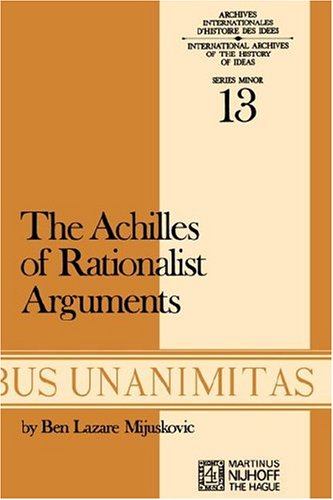

Mijuskovic chronicles the history of this argument from Plato through Kant in this unique study. His contribution to the history of the simplicity argument is one of a systematizer. The argument has been utilized by the likes of Plato, Plotinus, Descartes, Leibniz, and the Cambridge Platonists. Mijuskovic specifically discusses the benefits of its use in three particular debates: personal immortality, the unity of consciousness, and personal identity.
The simplicity argument has a fundamental premise of the immateriality of thought. Thought being immaterial implies that the mind is a simple substance. Three conclusions can be made about the human mind from this initial observation of its simplicity (1) what is simple is indestructible, (2) what is simple is unified, (3) what is simple is an identity. These three prongs are fleshed out in subsequent chapters within The Achilles of Rationalist Arguments. This basic argument has been analyzed since Plato. Mijuskovic’s genius is in observing how it has been used throughout history. The Achilles of Rationalist Arguments primarily focuses upon the Cambridge Platonists, but it establishes a method for future consideration of others who have benefited from its use.
This heroic contribution emerged in a somewhat hostile environment of academic materialism. Fortunately, there seems to be a swelling interest in the 21st century regarding the simplicity of the soul and arguments pertaining to dualism in philosophy of mind. For this stance, Mijuskovic deserves much commendation.
Precursors
In an article published in 1971 entitled “Hume and Shaftesbury on the Self,” Mijuskovic briefly states the simplicity argument’s fundamental thesis, which he develops in his doctoral dissertation one year later. In the article’s seventh footnote, Mijuskovic delivers one of the early formulations of the simplicity argument’s first four uses:
This is the argument that Kant has justly made famous in his second paralogism where he refers to it as ‘the Achilles of all dialectical inferences in the pure doctrine of the soul’ [. . .] Since Plato’s Phaedo and Plotinus’s Enneads it has been used essentially for four purposes in the history of ideas: (a) to prove the immortality of the soul; (b) to argue that the possibility of consciousness presupposes an immaterial unity; (c) as an argument against the Epicurean-Hobbesian thesis that ‘senseless matter can think;’ and finally, by the ‘rationalists,’ in the seventeenth and eighteenth centuries, (d) as a basis for the establishment of personal identity.
This is one of the earliest published examples of what becomes a staple in Mijuskovic’s treatment of the simplicity argument. These four points constitute chapters 2 through 5 in The Achilles of Rationalist Arguments.
This footnote occurs in a passage treating Hume’s and Shaftesbury’s mutual disapproval of the rationalist conception of the simplicity and identity of the self. Hume’s bundle theory of the self would not allow for such a singular self, but his contention with the rationalists is interestingly not related to the premise of the immateriality of thought. Shaftesbury’s role in this debate comes through is influence upon Hume. Mijuskovic astutely observes, “in the entire section on personal identity Shaftesbury alone is mentioned, in a positive light, as the philosophical precursor to Hume’s own naturalistic account of the self.”[[1]] The philosophical contention seen between Hume/Shaftesbury and the rationalist/dogmatists is a fundamental dynamic in the simplicity argument’s history. In each era, the simplicity argument divides based upon its initial conclusion of the simplicity.
Mijuskovic’s next contribution comes two years later in “The Premise of the Transcendental Analytic” where he examines the logical bases for the Transcendental Deduction. Mijuskovic agrees with Norman Kemp Smith’s Commentary against Robert Paul Wolff’s Kant’s Theory of Mental Activity pertaining to the primacy of the consciousness of time over the unity of consciousness. Pertinent to the development of the simplicity argument is his explanation of the reworking of the Transcendental Deduction and Paralogisms between the first and second editions of The Critique of Pure Reason. Mijuskovic also develops the three purposes or uses of the simplicity argument that Kant addresses: a defense of the immortality, a defense of the unity of consciousness, and a ground for personal identity.
“Hume and Shaftesbury on the Self” and “The Premise of the Transcendental Analytic” provide early indications of the argument more completely discussed in The Achilles of Rationalist Arguments. As precursors, they illustrate the commitment Mijuskovic demonstrates in analyzing the original sources and grounding the simplicity argument in a thorough exploration of these well-noted detractors. Despite the criticisms of Shaftesbury, Hume and Kant, the simplicity argument emerges as a defense of idealism, illustrating its perennial and amoebic nature. In other words it will prove to be a pesky concept which is difficult to dismiss entirely as evidenced by its use in Hegelian idealism and Husserlian phenomenology.
 Ben Lazare Mijuskovic (1937-2026)