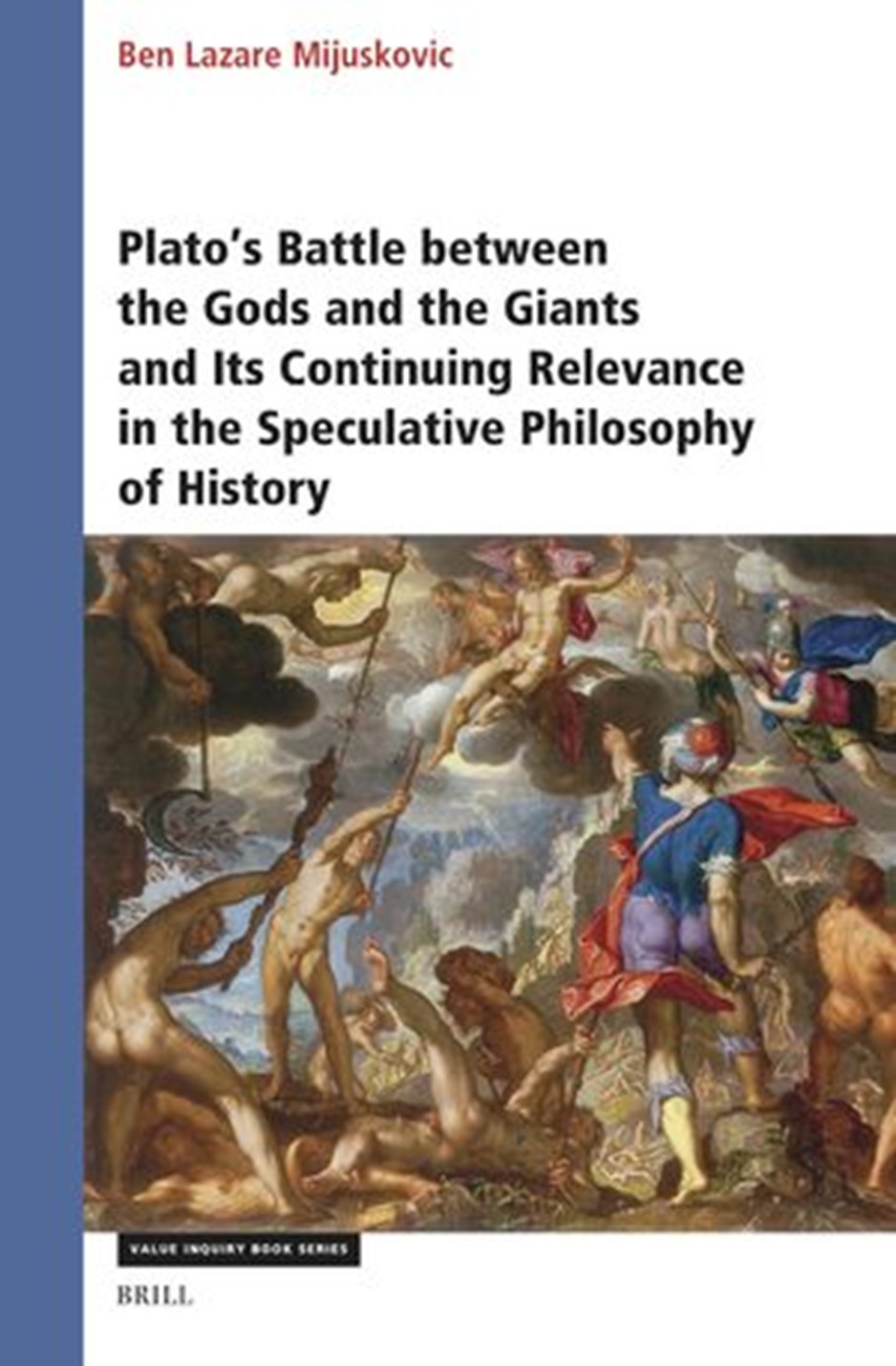
We are delighted to announce Dr. Mijuskovic’s New Release from Brill available now online titled Plato’s Battle between the Gods and the Giants and Its Continuing Relevance in the Speculative Philosophy of History.
In Volume 399 of the Value Inquiry Book Series, Mijuskovic draws from Platonic myth of Gigantomachia (Sophist 246a) to analyze the intellectual struggle between humanities and sciences to define the nature of human existence, meaning, and purpose. Mijuskovic surveys the history of philosophy to advocate for idealist, dualist, and phenomenological scholarship (Plato’s Gods) and to challenge materialist, reductive, and deterministic scholarship (Plato’s Giants). Plato’s Battle between the Gods and the Giants synthesizes decades of Mijuskovic’s individual studies in metaphysics, philosophy of mind, consciousness studies, and psychology to argue this case. Readers may consider revisiting his previous works in preparation for this latest contribution to further ground themselves in the History of Ideas framework Mijuskovic has used extensively.
Plato’s Battle between the Gods and the Giants engages classical philosophy, medieval philosophy, early Modern philosophy, and contemporary philosophy through an interdisciplinary lens, including works by Plotinus, Augustine, Leibniz, Kant, Schopenhauer, Dilthey, Brentano, Husserl, and Sartre in conversation with contemporary specialists.
Enjoy early access thorough Brill’s official site in part or in whole. We ask you to consider adding this to your personal or insitutional digital collection to complement his earlier Brill publication Consciousness and Loneliness: Theoria and Praxis.
- Cover Material
- Abstract: This book discusses two general theories of human consciousness. The methodology, interdisciplinary and “history of ideas”-oriented, concentrates on two opposing theories, one humanistic and the other scientific. Leibniz’s optimistic claim in the seventeenth century that this world was the best of all possible worlds is posed against nineteenth century Schopenhauer who argued pessimistically that it was the worst and that it was best not to survive. Against this background the book compares the current danger of a civil war in the United States of America as patterned along the same lines that engulfed the former Yugoslavia, thus demonstrating the insidious roots of that evil and its destructive engulfment and power. Ultimately, it questions whether these same dynamic forces are leading today’s world to annihilation as countries threaten each other with nuclear arms and the age of pessimism has become entrenched.
- Chapter 1 The Battle between Gods and Giants: Materialism and Idealism
- Abstract: The chapter starts with Plato’s dialogue in the Sophist when he presciently anticipates the conflict between Gods and Giants, the materialists and idealists in Western thought. As the conflict historically unfolds and continues between the materialists, mechanists, determinists, empiricists, phenomenalists, neuroscientists and now our current Artificial Intelligence proponents and all of them marshalled against the advocates for the consciousness of freedom, spontaneity, rationalism, subjective and objective idealism, phenomenology and existentialism, it pits Plato against Democritus, Plotinus against Epicurus, Augustine and Aquinas against Skeptics and Atheists, Ficino against Valla, Boehm against Bacon, Descartes against Hobbes, Leibniz against Locke, Kant against Hume, Hegel against Marx, and Copleston against Russell.
- Chapter 2 The Foundations of Western Science: Materialism, Empiricism, and Determinism
- Abstract: This chapter begins by citing an ancient metaphysical first principle, as it reductively grounds the multiple structures of our empirical sciences under the assumption that all reality is reducible to three underlying features. The interminable voids of space; the presence of innumerable material objects; and their supplemented motions throughout empty space. From these three assumed meta-principles, all else follows.
- Chapter 3 Metaphysical Dualism, Subjective and Objective Idealism: Freedom and Spontaneity
- Abstract: In the chapter, the following thinkers are discussed because of their dependence on the intrinsic activity of self-consciousness under various principles and guises, including the concept of Spontaneity in Plato, Aristotle, Descartes, Leibniz, Kant, Fichte, Hegel, Husserl, Sartre, and Stace; Emanationism in Plotinus and Proclus; Ecstasy in Augustine and in Sartre; Dynamism in Leibniz, Freud and Jung: qualitas occulta in Schopenhauer and Joseph Conrad; Intentionality in Brentano ad Husserl, etc. and all aligned against the scientific determinisms of the empirical sciences.
- Chapter 4 Brentano, Husserl, and Sartre on Transcendence, Intentionality, Spontaneity, and Values
- Abstract: In this chapter the author turns to a group of commentators on Brentano, Husserl, and Sartre including Herbert Spiegelberg, David Smith, Gaston Berger, Robert Sokowloski, Maurice Natanson, J. N. Mohanty, and Paul Ricoeur in demonstrating the contemporary continuity of the conceptual act of spontaneity of self-consciousness in the parlance of phenomenology and existentialism.
- Chapter 5 The Ancient Origins of Good and Evil: Closing the Circle
- Abstract: Dilthey’s lifelong philosophical ambition was to discover the formative laws underlying three competing “Weltanschauung,” a trio of clashing “world views,” each consisting in a metaphysical pursuit in establishing a critique of historical reason in the manner of Kant’s Critique of Pure Reason, as he sought to define a trio of ruling paradigms of world views in the History of Ideas context. In terms of his pursuit of universal philosophical principles and arguments, he distinguishes three metaphysical structures of thought: materialism; subjective idealism; and objective idealism. Each offers a different perspective on human consciousness and therefore values. The first consists of naturalism, which interprets the universe as logically unified through a deterministic system of cause-and-effect relations (Hobbes and Locke). The second is represented by subjective idealism or the philosophy of freedom, which seeks to understand mankind through the imposition of an order imposed upon him through the ethical strivings of the human will (Leibniz and Kant). And third is objective idealism, as deriving from an intuition of an underlying harmony of apparent conflicting antinomies and contradictions that are dialectically reconciled and resolved in an absolute system (Hegel).
- Chapter 6 Schopenhauer and Thomas Hardy: Optimism and Pessimism, the Virtues of Resignation and Compassion
- Abstract: While man is the most intelligent and most sensitive creature, he is also the unhappiest being under the sun. Human morality thus can only be based on compassion, and a resignation to the evil in the world. In the chapter, the author recruits a young Ph.D. candidate, Helen Garwood, who published her doctoral dissertation in 1919 on Schopenhauer and Hardy and confirmed by her correspondence with Hardy that much of Hardy’s disparagement of male narcissism and the evil of men was attributable to the influence of Schopenhauer.
- Chapter 7 The Ethics of Universal Suicide
- Abstract: Following the ideas of Schopenhauer and von Hartmann Hardy saw humanity as an essential part of a ‘universal consciousness’ perhaps prefiguring Carl Jung’s concept of self-awareness and self-knowledge as the most critical faculties of the mind. In his major novels, Hardy describes the tragic journey of his protagonists, usually females, toward spiritual self-awareness and self-knowledge. But in the end, he pulled his approval from von Hartmann’s all-pervasive pessimism about the value of human existence when the latter announced the virtuous annihilation of the human race.
Thank you for supporting Dr. Mijuskovic’s life long interdisciplinary project from Plato to Contemporary Philosophy.


 Ben Lazare Mijuskovic (1937-2026)