In an article published in 1971 entitled “Hume and Shaftesbury on the Self,” Mijuskovic briefly states the simplicity argument’s fundamental thesis, which he develops in his doctoral dissertation one year later. In the article’s seventh footnote, Mijuskovic delivers one of the early formulations of the simplicity argument’s first four uses:
This is the argument that Kant has justly made famous in his second paralogism where he refers to it as ‘the Achilles of all dialectical inferences in the pure doctrine of the soul’ [. . .] Since Plato’s Phaedo and Plotinus’s Enneads it has been used essentially for four purposes in the history of ideas: (a) to prove the immortality of the soul; (b) to argue that the possibility of consciousness presupposes an immaterial unity; (c) as an argument against the Epicurean-Hobbesian thesis that ‘senseless matter can think;’ and finally, by the ‘rationalists,’ in the seventeenth and eighteenth centuries, (d) as a basis for the establishment of personal identity.
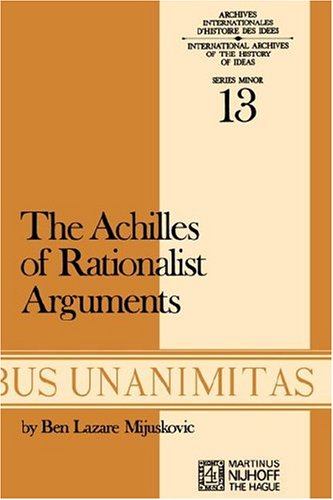
This is one of the earliest published examples of what becomes a staple in Mijuskovic’s treatment of the simplicity argument. These four points constitute chapters 2 through 5 in The Achilles of Rationalist Arguments.
This footnote occurs in a passage treating Hume’s and Shaftesbury’s mutual disapproval of the rationalist conception of the simplicity and identity of the self. Hume’s bundle theory of the self would not allow for such a singular self, but his contention with the rationalists is interestingly not related to the premise of the immateriality of thought. Shaftesbury’s role in this debate comes through is influence upon Hume. Mijuskovic astutely observes, “in the entire section on personal identity Shaftesbury alone is mentioned, in a positive light, as the philosophical precursor to Hume’s own naturalistic account of the self.”[[1]] The philosophical contention seen between Hume/Shaftesbury and the rationalist/dogmatists is a fundamental dynamic in the simplicity argument’s history. In each era, the simplicity argument divides based upon its initial conclusion of the simplicity.
Mijuskovic’s next contribution comes two years later in “The Premise of the Transcendental Analytic” where he examines the logical bases for the Transcendental Deduction. Mijuskovic agrees with Norman Kemp Smith’s Commentary against Robert Paul Wolff’s Kant’s Theory of Mental Activity pertaining to the primacy of the consciousness of time over the unity of consciousness. Pertinent to the development of the simplicity argument is his explanation of the reworking of the Transcendental Deduction and Paralogisms between the first and second editions of The Critique of Pure Reason. Mijuskovic also develops the three purposes or uses of the simplicity argument that Kant addresses: a defense of the immortality, a defense of the unity of consciousness, and a ground for personal identity.
“Hume and Shaftesbury on the Self” and “The Premise of the Transcendental Analytic” provide early indications of the argument more completely discussed in The Achilles of Rationalist Arguments. As precursors, they illustrate the commitment Mijuskovic demonstrates in analyzing the original sources and grounding the simplicity argument in a thorough exploration of these well-noted detractors. Despite the criticisms of Shaftesbury, Hume and Kant, the simplicity argument emerges as a defense of idealism, illustrating its perennial and amoebic nature. In other words it will prove to be a pesky concept which is difficult to dismiss entirely as evidenced by its use in Hegelian idealism and Husserlian phenomenology.


 Ben Lazare Mijuskovic (1937-2026)